
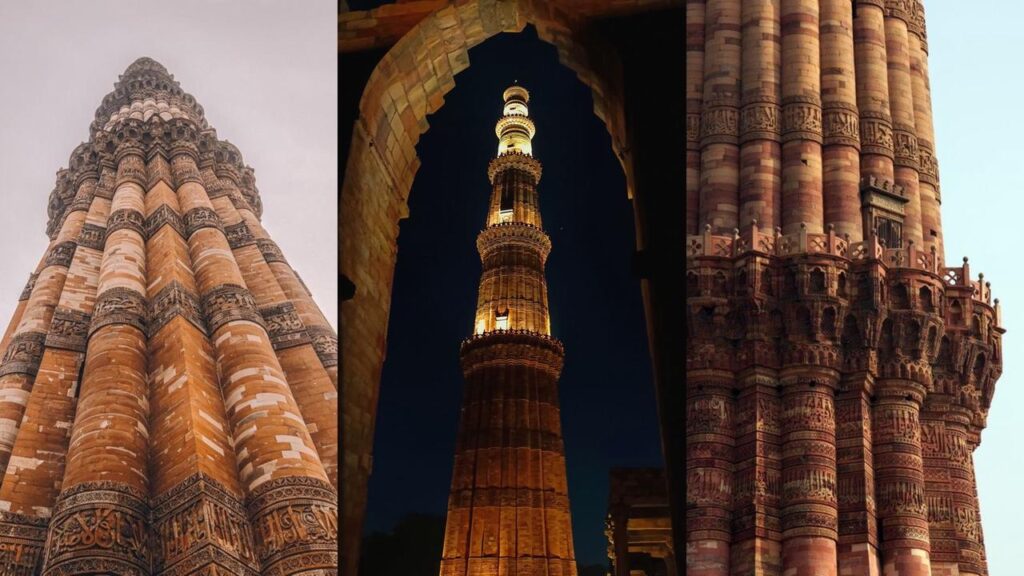
Qutub Minar, located in Qutub Minar New Delhi, is one of the tallest and most admired historical monuments in India. Counted among the most famous places in Delhi, Qutub Minar has evolved over centuries from a medieval victory tower into a globally recognized heritage monument. The Qutub Minar history reflects the early development of Indo-Islamic architecture in India.
Origin of Qutub Minar
The Qutub Minar history began in 1199 when Qutb-ud-din Aibak laid its foundation after the establishment of the Delhi Sultanate. The monument was constructed to celebrate military success and mark the beginning of Muslim rule in India, making it one of the earliest landmarks in Qutub Minar New Delhi.
Architectural Planning and Design
Qutub Minar is built mainly of red sandstone and marble. The tower showcases detailed carvings, verses from the Quran, and geometric patterns. Its five distinct storeys, each with a projecting balcony, represent the architectural development of different ruling periods and highlight why it is among the most famous places in Delhi.
Construction Under Different Rulers
After the death of Qutb-ud-din Aibak, his successor Iltutmish added three more storeys to the tower. Later, Firoz Shah Tughlaq rebuilt the upper floors after damage caused by lightning. These changes clearly show the gradual evolution described in Qutub Minar history over different dynasties.
Qutub Minar Complex
The Qutub Minar complex includes important structures such as the Quwwat-ul-Islam Mosque and the Iron Pillar. Together, they reflect the cultural and religious transformation of medieval India and add to the historical importance of Qutub Minar New Delhi.
Recognition as a World Heritage Site
In 1993, Qutub Minar was declared a UNESCO World Heritage Site. This recognition highlighted the global importance of Qutub Minar history and confirmed its place among the most valued heritage monuments and famous places in Delhi.
Modern Conservation Efforts
Today, Qutub Minar is protected by the Archaeological Survey of India. Conservation efforts focus on structural safety, controlled tourism, and preservation of carvings to protect this iconic monument in Qutub Minar New Delhi.
Conclusion
The evolution of Qutub Minar reflects centuries of history, architectural growth, and cultural change. From a victory tower to a world heritage monument, Qutub Minar history continues to inspire visitors and remains one of the most significant and famous places in Delhi.