
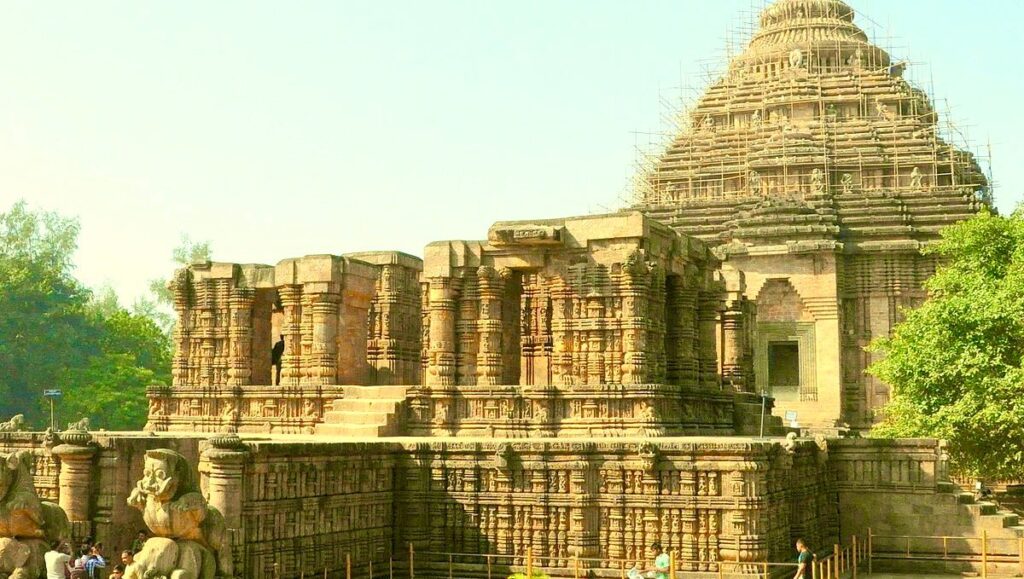
The Konark Sun Temple Odisha, located on the eastern coast of India, is not just a religious monument but a remarkable example of ancient Indian scientific knowledge and architectural brilliance. An important part of Konark Sun Temple history, this masterpiece was built in the 13th century by King Narasimhadeva I of the Eastern Ganga dynasty. Today, it is recognized as a UNESCO World Heritage Site and is counted among the famous temples in India, continuing to amaze historians, scientists, and architects across the world.
Chariot-Shaped Design: Engineering Genius
The temple is designed as a massive stone chariot of the Sun God, Surya, drawn by seven horses and mounted on 24 intricately carved wheels.
Each wheel acts like a sundial, accurately measuring time. The shadows cast by the spokes can calculate time to an accuracy of minutes, proving the advanced understanding of astronomy and mathematics found in Konark Sun Temple history.
Astronomical Alignment with the Sun
One of the most fascinating scientific aspects of the Konark Sun Temple Odisha is its perfect astronomical alignment with the Sun.
At dawn, the first rays of the rising sun once passed through the main entrance and illuminated the idol of Surya in the sanctum, reflecting deep knowledge of solar movement, angles, and seasonal shifts.
Advanced Stone Construction Techniques
The temple was constructed using Khondalite, laterite, and chlorite stones, carefully chosen for durability and artistic detail.
Instead of mortar, stones were joined using interlocking techniques, ensuring long-term stability. This advanced method allowed one of the famous temples in India to withstand centuries of harsh coastal weather.
The Magnetic Power Theory
According to popular belief mentioned in Konark Sun Temple history, a massive lodestone (magnet) was placed at the top of the temple.
It is said that this magnetic force caused the main idol to float in mid-air and even affected ship compasses along the Odisha coast. Although debated, this theory highlights early knowledge of magnetism and scientific experimentation.
Wheel Design and Mathematical Precision
Each of the 24 wheels has 8 major and 8 minor spokes, representing divisions of time such as hours, prahars, and seasons.
The carvings symbolize days, months, and cosmic cycles, showing a sophisticated understanding of timekeeping and calendrical science in the Konark Sun Temple Odisha.
Sound and Acoustics
The temple complex was designed to create a resonance effect during rituals. The architectural structure enhanced chants and sounds, indicating advanced knowledge of acoustics and sound reflection, similar to modern auditorium designs.
Symbolism Meets Science
Every sculpture and carving in the temple serves a dual purpose—artistic beauty and scientific symbolism.
The seven horses represent the seven days of the week, while the wheels signify the cycle of time and the universe, blending physics, astronomy, philosophy, and spirituality, a hallmark of many famous temples in India.
Why the Temple Collapsed
Despite its brilliance, parts of the temple collapsed due to structural stress, coastal erosion, and the removal of iron beams during colonial times. These iron beams were essential for maintaining balance, showing early use of metal reinforcement techniques in ancient Indian architecture.
Conclusion
The Konark Sun Temple Odisha stands as a timeless symbol of India’s ancient scientific wisdom. Its architectural precision, astronomical alignment, and engineering techniques make Konark Sun Temple history an outstanding example of how science and spirituality coexisted in ancient India. Even in ruins, it remains one of the most admired and famous temples in India, inspiring awe and curiosity worldwide.